
Our security staff maintains a friendly and supportive relationship with state and local law enforcement that assist us if the need arises. The end result is a campus that is secure as possible while allowing students the freedom to fully enjoy the campus.
Security officers also assist students with jump starting a dead battery, after hour escort, providing parking decals and student ID cards. They also investigate offenses, traffic accidents and medical emergencies on campus. The office is responsible for issuing parking registrations and enforcement of parking violations.
Rhodes State College Alert System
Clery Act/Annual Security Report
The Clery Act requires colleges and universities that receive federal funding to disseminate a public annual security report (ASR) to employees and students every October 1st. This ASR must include statistics of campus crime for the preceding 3 calendar years, plus details about efforts taken to improve campus safety. Please click on the link below to access the Rhodes State College Annual Security Report.
Clery Act Annual Security Report
Hazing Report
In compliance with Ohio Revised Code 2903.31 and College Policy 7.11 Anti-Hazing, hazing will not be tolerated at Rhodes State College. The College will investigate and respond to all reports of hazing as outlined in this Policy. Click on Hazing Report for a list of reported hazing incidents.
Tobacco-Free
Rhodes State College is a tobacco-free campus. The Tobacco-Free Policy at Rhodes State College requires that all faculty, students, staff, visitors, and contractors not use tobacco products on campus, either inside or out. The College strives to enhance the general health and well-being of its faculty, staff, students, and visitors. The College desires to support individuals to be tobacco-free, to achieve their highest state of health, and to launch students into their careers at a high level of health and wellbeing. To support this commitment, smoking and the use of tobacco and tobacco products are prohibited in or on all college-owned or leased property including vehicles.
Opioid Emergency Kits
Naloxone (Narcan) is a medication that can reverse an overdose caused by an opioid drug. When administered during an overdose, Narcan quickly restores breathing. Narcan has one important function: to stop overdose death by reversing the effects of opioids. Click on the link to learn where Campus Opioid kits are located and how to administer Narcan.
Emergency and General Inquiries: (419) 995-8499
Persons calling the (419) 995-8499 number should be aware that the conversations are on an open-air wave and can be heard by people with scanners. The 8499 number rings into the security officer’s radio, therefore allowing them to answer that number from anywhere on campus. Notice: they are not able to transfer you to another number, nor can they call you from the security radios. With this information in mind, it might be better for you to contact one of the other listed numbers for routine things. Of course, if there is an emergency, please call the 8499 number or 911.
Emergency Information
This Campus Emergency Guide is to give faculty, staff, and students guidance on how to handle various emergencies on the Rhodes State campus. In many cases, you will be instructed to call the Rhodes State Security Department at (419) 995-8499 or (8499) from any Rhodes State phone. Please note that if you are summoning emergency help by dialing 911, you will reach the Allen County Emergency Communications Center. While this information is helpful and informative, it is critical for you to read this information before an actual emergency.
Each specific emergency situation is unique; for that reason, no emergency guide can ever be comprehensive. However, in any emergency, it is always recommended that you remain calm; always be aware of the situation around you; and always report emergencies to Campus Security as soon as reasonably possible.
Emergency Phones and Call Boxes
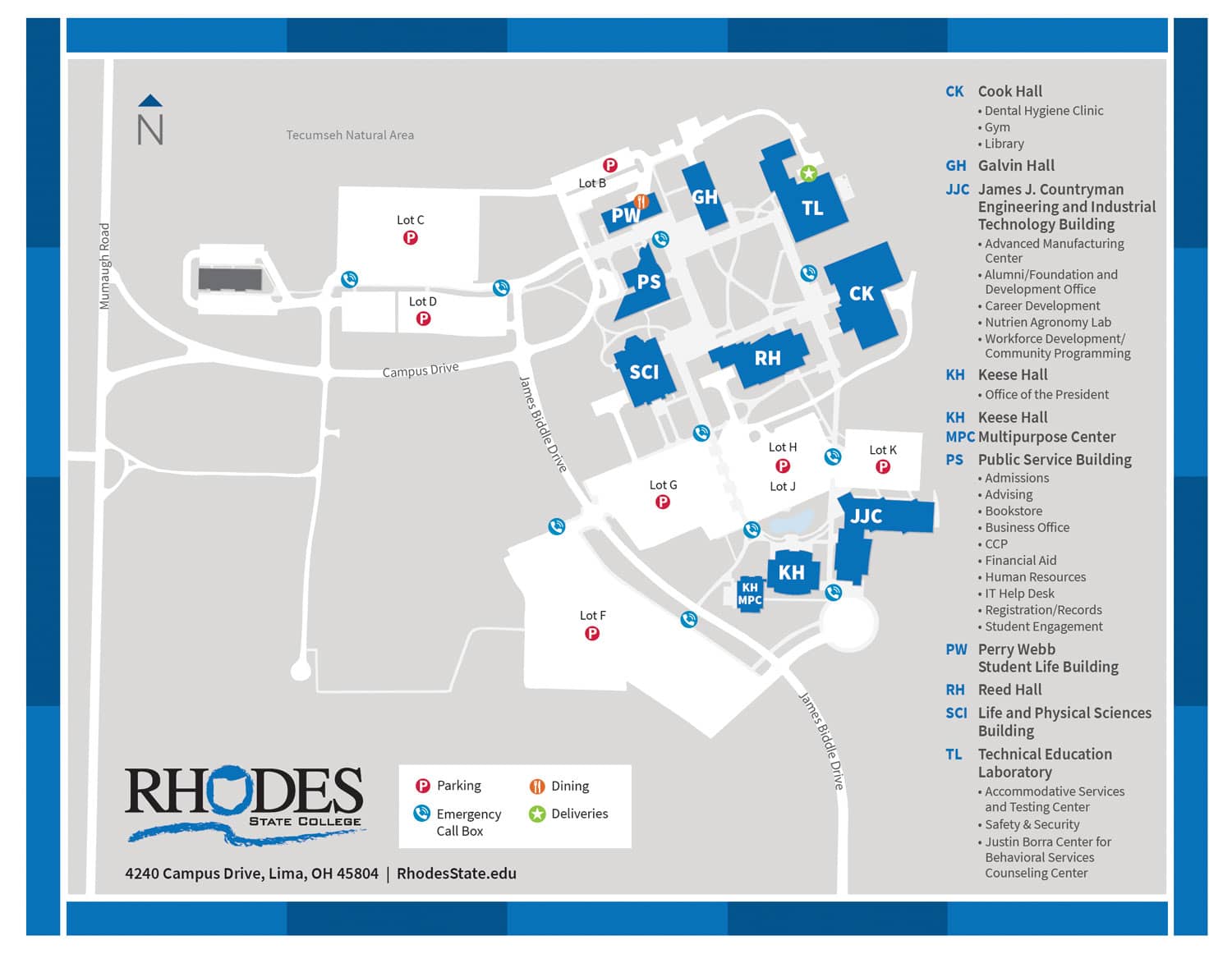
For campus emergency calls (police, fire, medical, or hazardous materials), dial 911. Emergencies can also be reported to the Rhodes State Security Department at (419) 995-8499 or 8499 from any Rhodes State phone. Call boxes, special emergency telephones, are located throughout campus that ring directly into the Rhodes State Public Safety Deparment.
Preparing for Emergencies
Sheltering in Place
“Sheltering in place,” means people make a shelter out of the place they are in or move to a designated shelter area. It is a way for people to make the building as safe as possible to protect themselves until help arrives. If there is time, shut and lock all outside doors and windows. Locking them may provide a tighter seal against the contaminant. Turn off the air conditioner or heater. Turn off all fans, too, and shut the doors.
Choose a room in your office with as few windows and doors as possible. A large room, preferably with a water supply, is desirable. For chemical events, this room should be as high in the structure as possible to avoid vapors (gases) that sink. The guideline is different from the sheltering in place technique used in tornadoes and other severe weather, when shelter should be low. It is suggested that the preparedness items previously listed be on hand in the shelter area.
Evacuation Procedures
Building Evacuation
Upon the decision to evacuate a campus building notification will come from Rhodes Alert, alarm, audible public address announcement, telephone, or in person.
Once you are notified, evacuation is required.
In preparation for the possibility of evacuation, you should understand the evacuation plan, and know at least two ways out of the building from your regular workspace. If you are notified to evacuate, remain calm but leave quickly; walk—do not run. As you exit, quickly check nearby restrooms, copy rooms, and storage rooms for personnel who may not be aware of the evacuation. Take only essential personal items with you; do not attempt to take large or heavy items. Close doors behind you as you leave. You should also assist and accompany persons with disabilities. Depending on the nature of the emergency, use of an elevator may be dangerous, especially if there is a possibility of becoming trapped inside due to power outage or mechanical failure. However, under some circumstances when the preferred routes of escape are blocked, it may be necessary to use elevators. On occasion, emergency personnel may operate elevators and instruct you to use it. Once out of the building, Security, Police or Fire Department personnel will instruct you to move to a designated safe area at least 300 feet away from the building.
Campus wide Evacuation
In most emergencies, complete evacuation of the entire campus is not necessary. If, however, there is a major hazardous materials release, flood, or other major incident, it may be necessary to relocate all campus individuals to a safer location. If you are instructed by authorities to evacuate the entire campus, do so immediately. If you are a person with a disability and need assistance leaving campus, contact the Rhodes State Public Safety Department at (419) 995-8499 or (8499) from any Rhodes State phone. Once the campus is evacuated, it will be secured and no one will be allowed to enter without proper authorization. The campus will remain closed until the decision to reopen is made by the President of Rhodes State or designee. Local radio and television stations will broadcast a notification when the campus is reopened.
Action Steps
Building Evacuations
- Remain calm.
- Walk quickly—DO NOT RUN.
- Do not use elevators, except to assist a person with a disability when:
- Evacuation is urgent;
- Use of an elevator is necessary; or
- An elevator is operated by Fire Department personnel.
- QUICKLY check restrooms, copy rooms, and storage rooms for people unaware of the evacuation.
Only take essential items with you. - Close doors behind you as you leave.
- Assist and accompany persons with disabilities.
- Move to designated area at least 300 feet away from building.
- Follow instructions by Police or Fire personnel.
Assisting People with Disabilities
The following information provides basic guidelines for assisting people with physical disabilities during an emergency evacuation. For more extensive information, please contact the Rhodes State Security Department at (419) 995-8499 or (8499) from any Rhodes State phone and request additional information on this topic.
Mobility Impaired
Since elevators should not be used for evacuation during an emergency, people with mobility impairments will need assistance evacuating. Individuals who can walk may be able to evacuate themselves. Walk with the person to provide assistance if necessary.
Evacuating individuals who are not able to walk is much more complicated. If there is no immediate danger, take the individual to a safe place to await emergency personnel. Whenever possible, someone should remain with the person while another individual exits the building and notifies emergency personnel of the mobility impaired person’s exact location.
Only in situations of extreme and immediate danger should you try to evacuate a wheelchair user yourself. The person with the disability is the best authority on how he/she should be moved. Ask before you move someone. While it is best to let professional emergency personnel conduct the evacuation, a person with mobility impairment can be carried by two people who have interlocked their arms to form a “chair” or by carrying the person in a sturdy office chair.
Visually Impaired
Tell the person with the visual impairment the nature of the emergency and offer to guide the person to the nearest exit. Have the person take your elbow and escort him/her out of the building. As you walk, advise the person of any obstacles. When you reach safety, orient the person to where he/she is and ask if any further assistance is necessary.
Hearing Impaired
Alert the person that there is an emergency by using hand gestures or by turning the light switch on and off. Verbalize or mouth instructions or provide the individual with a short note containing instructions. Offer assistance as you leave the building.
Action Steps
Mobility Impaired
- Designated helpers assist non-ambulatory persons to the nearest safe exit or stairwell.
- One helper remains with assisted person whenever possible.
- Other helper goes to ground level, notifies Fire and Police personnel that someone needs help.
- Fire and Police personnel complete the rescue.
Visually Impaired
- Explain nature of the emergency to visually impaired persons.
- Guide visually impaired persons to nearest safe exit.
- Provide further assistance as necessary.
Hearing Impaired
- Explain nature of the emergency to hearing-impaired persons (speak slowly and clearly or use writing).
- Guide hearing-impaired person to nearest safe exit.
- Provide further assistance as needed.
Elevators During an Emergency
If You Are Stuck in an Elevator
Call the Rhodes State Public Safety Department at (419) 995-8499 or (8499) from any Rhodes State phone or use the emergency call button in the elevator.
Active Shooter/Killer
Introduction
An active shooter/killer is a person who is actively engaged in killing or attempting to kill people in a populated area; in most cases, active shooters/killers use firearms and there is no pattern or method to their selection of victims. These situations are dynamic and evolve rapidly, demanding immediate deployment of law enforcement resources to stop the assault and mitigate harm to innocent victims. This document provides guidance to faculty, staff, and students who are in an active shooter/killer situation, and describes what to expect from responding police officers.
Guidance to faculty, staff, and students
In general, how you respond to an active shooter/killer is dictated by the specific circumstances of the encounter, bearing in mind there could be more than one person involved in the same situation. If you find yourself involved in an active shooter/killer situation, try to remain calm and use these guidelines to help you plan a strategy for survival.
Remember- Run, Hide, Fight.
RUN and escape, if possible.
- Getting away from the aggressor is the top priority.
- Leave your belongings behind and get away.
- Help others escape, if possible, but evacuate regardless of whether others agree to follow.
- Warn and prevent individuals from entering an area where the active shooter may be.
- Call 911 when you are safe, and describe shooter, location, and weapons.
HIDE, if escape is not possible.
- Get out of the aggressors view and stay very quiet.
- Silence all electronic devices and make sure they won’t vibrate.
- Lock and barricade doors, close blinds, and turn off lights.
- Do not hide in groups, spread out along walls or hide separately to make it more difficult for the aggressor.
- Try to communicate with police silently. Use text message or social media, or put a sign in a window.
- Stay in place until law enforcement gives you the all clear.
- Your hiding place should be out of the aggressors view and provide protection if shots are fired in your direction.
FIGHT as an absolute last resort.
- Commit to your actions and act as aggressively as possible against the attacker.
- Recruit others to ambush the aggressor with makeshift weapons like chairs, fire extinguishers, scissors, books, etc.
- Be prepared to cause severe or lethal injury to the aggressor.
- Throw items and improvise weapons to distract and disarm the aggressor.
- What to expect from responding police officers.
Keep hands visible and empty. - Know that law enforcement’s first task is to end the incident, and they may have to pass injured along the way.
- Officers may be armed with rifles, shotguns, and/or handguns and may use pepper spray or tear gas to control the situation.
- Officers will shout commands and may push individuals to the ground for their safety.
- Follow law enforcement instructions and evacuate in the direction they come from, unless otherwise instructed.
- Take care of yourself first, and then you may be able to help the wounded before first responders arrive.
- If the injured are in immediate danger, help get them to safety.
- While you wait for first responder to arrive, provide first aid. Apply direct pressure to wounded areas and use tourniquets if you have been trained to do so.
- Turn wounded people onto their sides if they are unconscious and keep them warm.
- Consider seeking professional help for you and your family to cope with the long-term effects of the trauma.
Action Steps
If an active shooter/killer enters your office, area, or classroom:
Run – Getting away from the aggressor is the top priority. Leave your belongings behind and get away. Help others escape, if possible, but evacuate regardless of whether others agree to follow. Warn and prevent individuals from entering an area where the aggressor may be. Call 911 when you are safe, and describe aggressor, location, and weapons.
Hide – Get out of the aggressors view and stay very quiet. Silence all electronic devices and make sure they won’t vibrate. Lock and barricade doors, close blinds, and turn off lights. Do not hide in groups- spread out along walls or hide separately to make it more difficult for the aggressor. Try to communicate with police silently. Use text message or social media to tag your location, or put a sign in a window. Stay in place until law enforcement gives you the all clear. Your hiding place should be out of the aggressors view and provide protection if shots are fired in your direction.
Fight – Commit to your actions and act as aggressively as possible against the attacker. Recruit others to ambush the aggressor with makeshift weapons like chairs, fire extinguishers, scissors, books, etc. Be prepared to cause severe or lethal injury to the aggressor. Throw items and improvise weapons to distract and disarm the attacker.
If you decide to flee during an active shooter situation:
Do no attempt to carry anything.
Move quickly, keep your hands visible and follow the instructions of any police officers you may encounter.
Do not attempt to remove injured people. Notify authorities of their location as soon as possible. Police and Security personnel will assist you.
IMPORTANT: Unfamiliar voices may be the shooter attempting to lure victims from their safe space. Do not respond to any voice commands until you can verify the source.
Workplace Violence
Workplace violence often begins with inappropriate behavior or signs that, when detected and reported, may help prevent its occurrence. The following information is a starting place for workplace violence education and a safer, healthier workplace for everyone.
Risk Factors That Contribute to Workplace Violence
- Termination of employment.
- Disciplinary actions.
- Ongoing conflicts between employees.
- Domestic or family violence.
- Financial problems.
Preventing Workplace Violence
- Be aware of what is going on around you at all times. Awareness is a proven method for increased personal safety.
- Tell your supervisor when you notice unusual or suspicious behavior.
- Attend a violence prevention training that includes training in conflict resolution and positive ways of dealing with hostile individuals.
- Get acquainted with Rhodes State Public Safety officers; do not hesitate to call for help.
- Remember—a safe workplace is everyone’s responsibility.
- Contact the Rhodes State Public Safety Department at (419) 995-8499 or (8499) from any Rhodes State phone to report an incident.
Examples of Workplace Violence:
- Threats direct or implied.
- Physical conduct that results in harm to people or property.
- Conduct that harasses, disrupts, or interferes with another individual’s performance.
- Conduct that creates an intimidating, offensive, or hostile environment.
Potential Warning Signs
- Verbal, nonverbal, or written threats.
- Fascination with weapons or violence.
- New or increased stress at home or work.
- Expressions of hopelessness or anxiety.
- Insubordinate behavior.
- Dramatic change in work performance.
- Destruction of property.
- Drug or alcohol abuse.
- Externalization of blame.
Reporting Workplace Violence
Report ALL incidents of workplace violence to the Rhodes State Public Safety Department at (419) 995-8499 or (8499) from any Rhodes State phone.
Hostage Situation
If you are involved in a hostage situation take steps not to aggravate the situation. Remain calm and encourage others around you to remain calm. If possible, dial 911 or the Rhodes State Public Safety Department at (419) 995-8499 or (8499) from any Rhodes State phone. DO NOT argue or attempt to negotiate.
If you are involved in a hostage situation:
- Dial 911 or (419) 995-8499 or (8499) from any Rhodes State phone, if possible, and supply as many details as possible including:
- Number of people involved
- Description of hostage taker(s)
- Weapons displayed
- Threats made
- Any other information
- Do what you are told without argument.
- Do not attempt to negotiate or argue with the hostage taker.
- Try to get others to remain calm. Tell them to do what they are told.
Medical Emergencies
Medical emergencies may include any life-threatening situation, including the following:
- Broken bones
- Cessation of breathing
- Chest pain
- Excessive bleeding
- Eye injuries
- Head injury
- Heat stroke/heat exhaustion/heat cramps
- Inhalation of a toxic substance
- Lacerations
- Seizure
- Serious allergic reactions
- Unconsciousness
If you or someone in your office/class experiences a medical emergency, call 911 then (419) 995-8499 or (8499) from any Rhodes State phone immediately. Rhodes State Public Safety will assess the situation and provide required services.
Unless you have training, do not try to render any first aid or use CPR before assistance arrives. If you have training in CPR and it is needed, use CPR. If trained in first aid, use pressure to stop bleeding. Do not move a victim unless safety dictates.
Rhodes State has stationed AED’s (Automated External Defibrillators) in every building on campus. If a person is in cardiac arrest, the AED can analyze a patient’s need for electroshock treatment and administer the shock automatically.
Unless you are properly trained, do not try to render first aid with an AED.
If you experience or witness a medical emergency:
- Call 911 then (419) 995-8499 or (8499) from any Rhodes State phone immediately.
- Remain calm.
- Be prepared to provide information about the emergency.
- Unless trained, DO NOT render first aid—wait for emergency personnel.
- IF TRAINED, use pressure to stop bleeding.
- IF TRAINED, use CPR if victim has NO PULSE and is NOT BREATHING.
- Do not move a victim unless safety dictates.
- Be prepared to provide Rhodes State Security with vital information, such as:
- Your name and telephone number
- Location of the injured person (building, room, etc.)
- Type of injury or problem
- Individual’s present condition
- Sequence of events leading to the emergency
- Medical history and name of injured person’s doctor, if known
- Stay on phone with emergency personnel
- Alert others of the emergency, if possible
Fire Emergency
- In case of fire call 911 then Rhodes State Public Safety Department at (419) 995-8499 or (8499) from any Rhodes State phone.
- One way to prepare for fire emergencies is to know the different types of fire extinguishers and be trained in their use.
- Under NO, circumstances should an employee attempt to extinguish a fire, unless the employee has training in the use of fire extinguishers. You can also prepare for a fire emergency by knowing your building’s evacuation plan, and by learning first aid.
Extinguisher Types
- Type A – Paper & wood
- Type B – Flammable liquids & gas
- Type C – Electrical & appliances
- Type ABC – Paper, flammable liquid & electric
- Type D – Certain metals
- Type K – Kitchen Grease Fires
If a fire alarm is activated:
- Evacuate building immediately; close doors behind you.
- DO NOT try to save belongings, files, or equipment.
- DO NOT go to the basement.
- DO NOT use elevators.
- Help people with disabilities leave the building if possible.
- Tell Fire personnel or Rhodes State Security the location of disabled persons remaining in the building.
- Proceed to a point at least 300 feet away from the building.
- Stay clear of firefighting equipment.
- If you activated the fire alarm, meet with Fire, Police or Security personnel to identify the location of smoke or fire.
If you discover a fire:
- Evacuate building immediately.
- DO NOT use elevators.
- Activate the closest fire alarm as you exit, if possible.
- Call 911 and then the Rhodes State Public Safety Department at (419) 995-8499 or (8499) from any Rhodes State phone.
- Use fire extinguisher ONLY IF trained in its proper use.
If in doubt about the seriousness of a fire:
- Evacuate building immediately.
- DO NOT use elevators.
- Activate the closest fire alarm as you exit, if possible.
- Call 911 then the Rhodes State Public Safety Department at (419) 995-8499 or (8499) from any Rhodes State phone.
- Stay 300 feet from the building and emergency equipment.
- Do not reenter the building until instructed by Fire, Police or Security personnel.
If your clothes catch on fire:
- STOP whatever you are doing; do not run.
- DROP to the ground.
- ROLL to smother flames.
Render first aid as necessary:
- DO NOT ATTEMPT TO MOVE PERSONS WHO HAVE EXTREME INJURIES.
- Get help from Fire, Police or Security personnel.
- Administer CPR/First aid, if trained to do
Bomb Threats
If you receive a telephone bomb threat:
- Listen carefully. Be polite and show interest. Try to keep the caller talking so that you can gather more informatio